Work Group Computer Graphics and Media Design
Welcome on our web site! The department of computer graphics and media informatics focusses on three research areas:
- Modeling and Visualization of complex Objects
Many applications in urban and environmental planning, in architecture, landscaping, ecology, arts, film and advertisement need complex objects and scenes for various types of visualizations. We found efficient algorithms for the creation, level-of-detail modeling and display of scenes with billions of surfaces. Our work concentrated on botanic objects (trees, landscapes). Already in 1996 I founded the companies Greenworks Organic Software and later Xfrog, Inc. to develop programs for plant modeling. One product is the well-known xfrog modeling software, which is used widely and was involved in many movie productions such as Avatar. Together with the Chinese Academy of Sciences we developed a completely new method to represent scanned tree objects, thus enabling data-driven models to be shown efficiently in computer graphics scenes.
- Sampling and Rendering
Sampling is one of the basic problems of computer graphics. Good sampling strategies allow producing images with reduced or special kinds of noise. For many years it was not clear what characterizes good sampling sets. We developed various methods to produce such sets and finally found a mathematical description that allows characterizing and tuning such sets optimally.
- Non-photorealistic Rendering
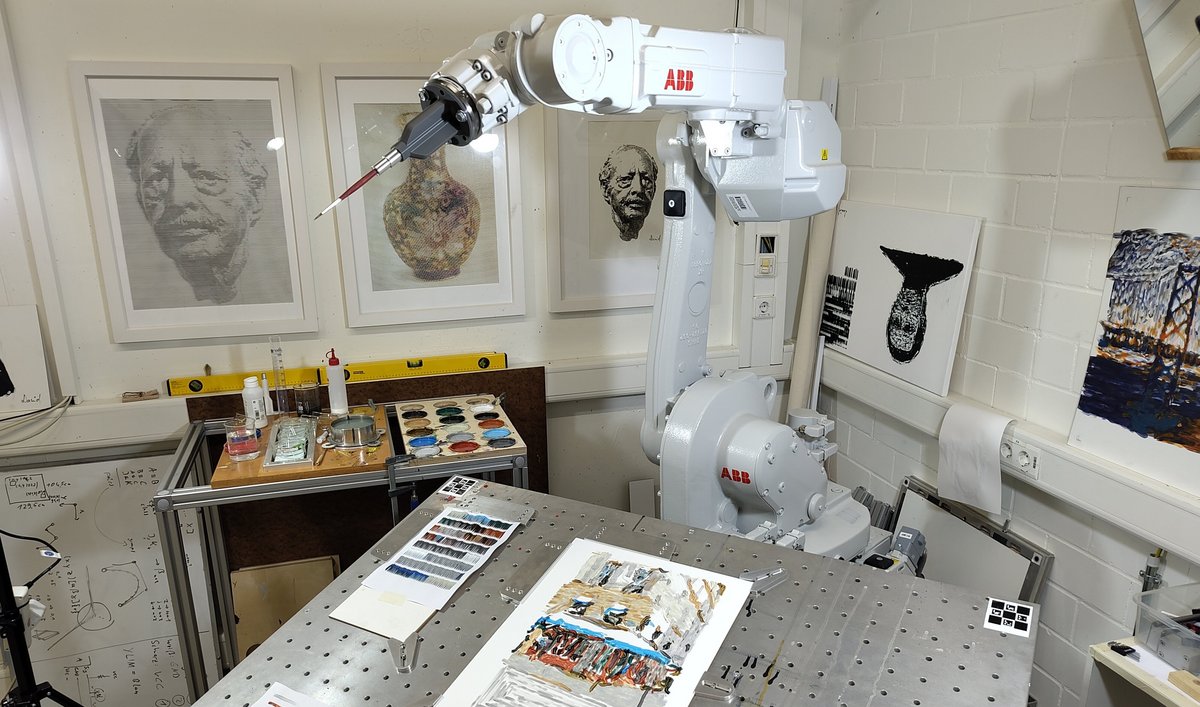
These techniques aim at creating abstract visual representations for various applications in simulation, visualization, film and arts. In contrast to the traditional rendering paradigm of creating images that are indistinguishable from photographs, non-photorealistic (abstract) rendering allows to vary geometric details, alter shading styles and modify the geometric representation within a single image. The attention of the viewer can be directed to intended parts, representational styles can help her/him understanding relations between objects, to distinguish between existing and planned objects and much more. Dealing with such rendering techniques allows medical and psychological researchers furthermore to explore and understand the working of our visual system. One project in this research area is our drawing robot eDavid
- Information Visualization
This area tries to encode various kinds of information visually in the form of computer images. Such encodings help to visually explore complex data and are used in combination with data mining techniques. In particular we worked in software visualization to structurally evaluate very large software systems, in visualization for Biology and Chemistry and text visualization. The latter one might sound strange since text itself is a visualization. However, large amounts of text such as software systems of large text corpora tend to get invisible since they cannot be comprehended by reading any more. Visualization techniques allow assessing such corpora, the linguistic analysis enables systems to detect important themes and topics. Within the BW-FIT Projektverbund we investigated visualization methods for large high-resolution displays. Another project is INCIDE, where we develop new visualisation methods for life sciences.
Teaching
The courses given in this term can be found on the teaching page or in the LSF system.
Theses and Internships
Interested students are welcome to contribute to current research topics for bachelor or master theses. We also offer various internships in cooperation with industry partners. For further information, please consult these separate pages.